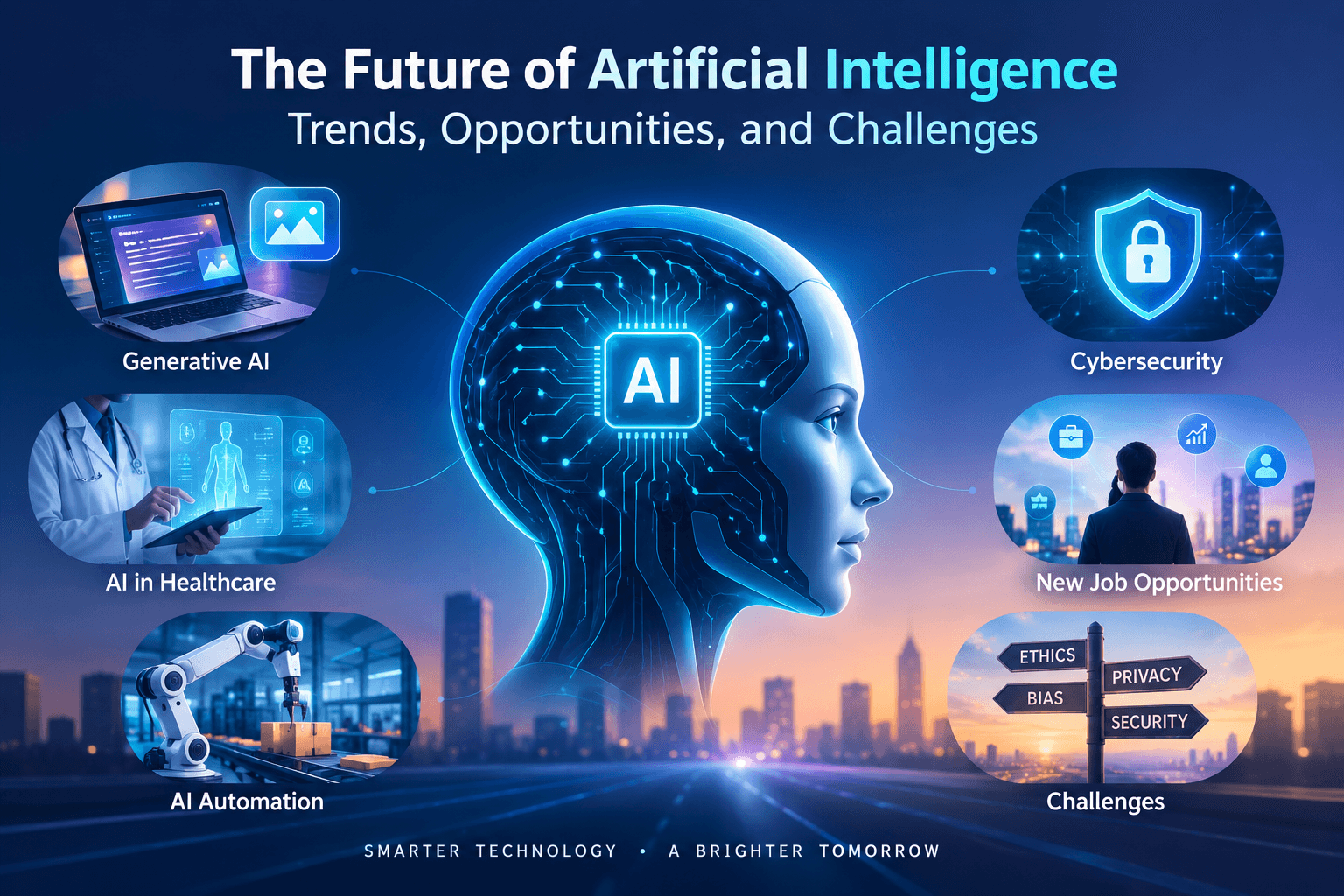
Artificial intelligence is changing how people work, communicate, learn, and solve everyday problems. From AI assistants and intelligent search tools to advanced healthcare systems and automated business processes, AI is becoming an important part of modern technology. But what does the future of artificial intelligence actually look like? In the coming years, AI may become more capable, efficient, and deeply integrated into the software and services people use every day. At the same time, businesses and technology professionals will need to address important challenges involving privacy, security, accuracy, employment, and responsible AI development. In this article, we’ll explore the major AI trends, its potential impact on different industries, career opportunities, challenges, and practical ways to prepare for the future of AI.
What Is the Future of Artificial Intelligence?
The future of artificial intelligence refers to the continued development and adoption of AI technologies across different areas of technology, business, science, and everyday life. Modern AI systems can already recognize patterns, understand natural language, analyze data, generate content, and assist with complex tasks. Future systems are expected to become more capable while also becoming more efficient and easier to integrate into existing applications. Some important areas shaping the future of AI include:
- Generative AI
- Machine learning
- AI automation
- AI agents
- Natural language processing
- Multimodal AI
- Robotics
- Edge AI and on-device AI The pace of development will depend on factors such as computing resources, data quality, research, investment, regulation, and responsible technology development. Major Artificial Intelligence Trends
1. Generative AI Will Continue to Evolve
Generative AI has become one of the most visible areas of artificial intelligence. Unlike systems designed mainly to classify or predict information, generative AI can create new content such as text, images, audio, video, and computer code. Businesses are increasingly exploring generative AI for tasks such as writing assistance, document summarization, software development, customer support, and content creation. For example, an employee could use an AI assistant to summarize a long report and create a list of important points. A developer could use an AI coding assistant to explain an error or generate a starting point for a software function. However, AI-generated content still requires human review. AI systems can produce incorrect information or misunderstand the context of a request.
2. AI Agents May Handle More Complex Workflows
AI agents are systems designed to work toward a goal by taking multiple actions and using available tools. A basic chatbot may answer a question, while an AI agent could potentially complete several connected steps. For example, a customer-support agent might identify a user's request, search a knowledge base, prepare a response, and escalate the issue when human assistance is required. Potential business applications include:
- Customer support
- Document processing
- Software development
- Data analysis
- IT operations
- Business workflow automation The main challenge is reliability. AI agents need appropriate permissions, clear limits, monitoring, and human oversight when their actions have important consequences.
3. Multimodal AI Will Become More Important
Multimodal AI can work with different types of information, including text, images, audio, and video. For example, a user could provide an image and ask an AI system to explain what it contains. A multimodal assistant could also combine spoken instructions with visual information to provide a more useful response. This technology has potential applications in:
- Education
- Healthcare
- Accessibility
- Technical support
- Customer service
- Content creation As multimodal AI improves, interacting with computers may become more natural because users will not have to rely only on typed commands.
4. Smaller and More Efficient AI Models
Large AI models can require substantial computing resources. As a result, developing smaller and more efficient models is an important area of AI research. Some AI applications can run directly on smartphones, laptops, or other devices. This is commonly associated with edge AI or on-device AI. Potential advantages include:
- Faster responses for suitable tasks
- Reduced dependence on cloud services
- Better control over certain types of data
- Lower computing requirements The best model depends on the application. A smaller model may be appropriate for a simple task, while a more capable model may be required for complex reasoning or specialized workloads. How AI Will Transform Different Industries Artificial intelligence has applications across many industries, although its impact will vary depending on how the technology is implemented. AI in Healthcare Healthcare is an important area for AI development. AI systems can assist professionals with tasks such as analyzing medical images, organizing information, researching potential treatments, and monitoring data. Potential applications include:
- Medical image analysis
- Drug discovery research
- Patient monitoring
- Administrative automation
- Healthcare data analysis AI should be treated as a support technology rather than a replacement for qualified healthcare professionals. Important medical decisions require appropriate clinical judgment and human oversight.
AI in Education
AI is creating new possibilities for students, teachers, and educational platforms. An AI learning assistant can explain difficult concepts, generate practice questions, provide feedback, or help students understand programming errors. Teachers may also use AI tools to organize learning materials, prepare activities, and create educational content. However, schools and students need to consider accuracy, privacy, academic integrity, and the risk of becoming overly dependent on automated tools.
AI in Cybersecurity
Artificial intelligence can help cybersecurity teams process large amounts of security information and identify unusual activity. For example, an AI-powered security system could detect an unusual login pattern and alert a security professional for investigation. AI may support cybersecurity activities such as:
- Monitoring network activity
- Analyzing security logs
- Detecting unusual behavior
- Prioritizing security alerts
- Supporting incident investigations AI can also be misused by attackers, which means organizations need strong security practices and continuous monitoring.
AI in Business and Automation
Businesses are using AI to assist with repetitive and information-heavy tasks. AI can help employees summarize documents, analyze customer feedback, organize information, and prepare drafts. For example, an online business could use AI to categorize customer questions and help support employees prepare responses. As AI systems become better integrated with business software, more complex workflows may become partially automated. Companies still need to consider accuracy, data protection, cost, and human oversight before automating important processes. Will Artificial Intelligence Replace Human Jobs? The effect of AI on employment is one of the most discussed topics surrounding the future of artificial intelligence. AI can automate individual tasks, particularly tasks involving repetitive information processing. This does not necessarily mean that an entire occupation will disappear. Many jobs involve a combination of technical knowledge, communication, creativity, judgment, collaboration, and responsibility. AI may change how these jobs are performed rather than simply eliminating them. Some roles may evolve while new opportunities emerge in areas such as:
- AI engineering
- Machine learning
- Data science
- AI infrastructure
- Cybersecurity
- AI governance
- AI-assisted software development For students and IT professionals, learning how to work effectively with AI tools can be useful alongside developing strong technical and problem-solving skills.
The Role of AI in Software Development
Artificial intelligence is already influencing software development. AI coding assistants can help developers generate code, explain programming concepts, identify potential errors, write documentation, and create test cases. For example, a developer working on an application could ask an AI assistant to explain an error message or suggest a possible implementation. Future AI development tools may support more stages of the software development lifecycle, including:
- Code generation
- Code review
- Testing
- Documentation
- Debugging
- Software maintenance Developers still need to review AI-generated code carefully. Generated code can contain bugs, security vulnerabilities, inefficient approaches, or incorrect assumptions. Human developers remain important for understanding requirements, designing systems, reviewing solutions, and making technical decisions. Challenges and Risks of Artificial Intelligence The future of AI also involves significant challenges.
Data Privacy and Security
AI applications may process large amounts of information. If sensitive data is collected or handled incorrectly, it can create privacy and security problems. Organizations should use appropriate security controls, access management, data policies, and privacy practices when deploying AI systems.
Bias and Fairness
AI systems can learn patterns from their training data. If the underlying data contains biases or does not adequately represent the intended population, an AI system may produce unfair results. Testing, monitoring, appropriate data practices, and human review can help organizations identify and reduce these problems.
Incorrect Information
AI systems can sometimes produce answers that appear convincing but are incorrect. This is particularly important when AI is used for high-impact decisions or professional work. Important information should be verified using reliable sources and appropriate expertise.
Energy and Computing Requirements
Some AI systems require substantial computing resources for training and operation. Data centers also require electricity and cooling. Improving model efficiency and hardware performance can help reduce the resources needed for suitable AI applications.
Responsible AI Development
Responsible AI means considering factors such as safety, privacy, fairness, transparency, security, and accountability when developing and deploying AI systems. Organizations need to establish clear policies around how AI can be used, when human review is required, and who is responsible for important decisions.
How to Prepare for the Future of AI
You don't need to become an AI researcher to prepare for changes in artificial intelligence.
1. Learn the Fundamentals
Start by understanding basic concepts such as machine learning, neural networks, generative AI, training data, and AI models.
2. Develop Technical Skills
Learning programming, particularly Python, can provide a useful foundation for exploring AI and data-related technologies. You can also learn about databases, cloud computing, APIs, and software development.
3. Experiment With AI Tools
Use AI tools for learning, research, coding, brainstorming, and productivity. At the same time, practice checking AI-generated information instead of automatically trusting every response.
4. Build Practical Projects
Small projects can help turn theoretical knowledge into practical skills. For example, beginners could build a simple chatbot, data-analysis application, recommendation system, or AI-powered productivity tool.
5. Keep Learning
AI technology changes quickly. Follow reliable technical documentation, take relevant courses, read research summaries, and experiment with new tools as they become available.
What Could AI Look Like in the Next Decade?
It is difficult to predict exactly how artificial intelligence will develop over the next decade. However, several areas are worth watching. AI may become more deeply integrated into everyday software, business systems, scientific research, and digital services. Possible developments include:
- More personalized digital assistants
- More AI-supported business workflows
- Improved multimodal interaction
- Greater use of AI in scientific research
- More efficient AI models
- Increased focus on AI safety and governance The timing and scale of these developments remain uncertain. Technical limitations, regulation, economic conditions, research breakthroughs, and public adoption will all influence the direction of AI. Frequently Asked Questions
What is the future of artificial intelligence?
The future of artificial intelligence involves developing more capable, efficient, and useful AI systems for areas such as automation, software development, healthcare, education, research, and business.
Will artificial intelligence replace humans?
AI may automate certain tasks performed by humans, but the effect will vary between occupations. Many jobs also require communication, creativity, judgment, collaboration, and accountability.
Which industries will benefit from AI?
Healthcare, education, cybersecurity, software development, manufacturing, finance, transportation, and many other industries are exploring AI applications. The benefits will depend on the specific use case and implementation.
Is AI a good career field?
AI-related careers include machine learning, data science, AI engineering, software development, AI infrastructure, and cybersecurity. Building strong technical fundamentals can help people explore these areas.
How can beginners learn artificial intelligence?
Beginners can start with basic AI concepts, learn Python, study data analysis and machine learning fundamentals, experiment with AI tools, and build small practical projects.
Conclusion:
The future of artificial intelligence is already taking shape, so the best way to prepare is to start learning and experimenting today. You don't need to become an AI expert overnight. Begin with the basics, understand how AI tools work, and gradually develop practical skills that match your interests. If you're a student, consider learning Python, data analysis, and basic machine learning. If you're an IT professional, explore how AI can improve your existing workflow and strengthen your skills in areas such as software development, cloud computing, cybersecurity, or data engineering. Most importantly, learn to use AI responsibly. Check important information, protect sensitive data, and treat AI-generated results as assistance rather than unquestionable answers. AI will continue to change, but the ability to learn, adapt, and solve real problems will remain valuable. Start with one useful AI tool or project, learn from the experience, and build your knowledge step by step. That's a practical way to prepare for the future of artificial intelligence.
Comments
No comments yet. Add the first one below.